
The 70/70 test is the single biggest accountability mechanism in Workforce Pell. Fail it, and your program is locked out for two years. Here’s how to see it coming, and how to stay ahead of it.
If you take away one thing from this series, let it be this: the 70/70 test is the gatekeeper.
Every Workforce Pell-eligible program must demonstrate two things:
≥70% of students complete the program. Not “persist” — complete. Finish the hours, earn the credential.
≥70% of completers are employed in the second quarter after exiting the program (roughly 180 days). For the first three award years (2026–27 through 2028–29), any employment in that window counts. Starting in 2029–30, the standard tightens: students must be working in the occupation the program prepared them for, or a similar high-skill, high-wage, or in-demand occupation.
There’s also a third metric, value-added earnings, that requires graduates’ median earnings to exceed the total cost of the program. But this one has a grace period: official earnings calculations don’t begin until the 2030–31 award year, giving programs that start enrolling in 2026–27 a four-year window before ROI metrics are fully enforced.
The completion and placement tests? Those are immediate. And the penalty for failing is severe.
The Two-Year Lockout
If the Department of Education determines that a program fails the completion and/or job placement requirements, the institution can’t re-establish that program, or a “substantially similar” one with the same 4-digit CIP and overlapping SOC codes, for two years.
That’s not a warning. That’s not a probation period. That’s a hard lockout. Two full award years without access to Workforce Pell funding for that program and anything that looks like it.
The institutions that get hurt by this won’t be the ones with bad programs. They’ll be the ones that didn’t see it coming because they lacked the real-time visibility to track completion and placement trends before they crossed the threshold.
You Need to See It Coming
The 70/70 test isn’t something you should learn about from a federal compliance letter. It’s something you should be monitoring continuously program by program, month by month, so you can intervene before a metric drops below 70%.
That means you need dashboards, not annual reports. You need trend lines, not point-in-time snapshots. You need program-level status indicators, On Track, Watch, At Risk, so leadership, deans, and program directors know exactly where to focus.
What Real-Time 70/70 Monitoring Could Look Like
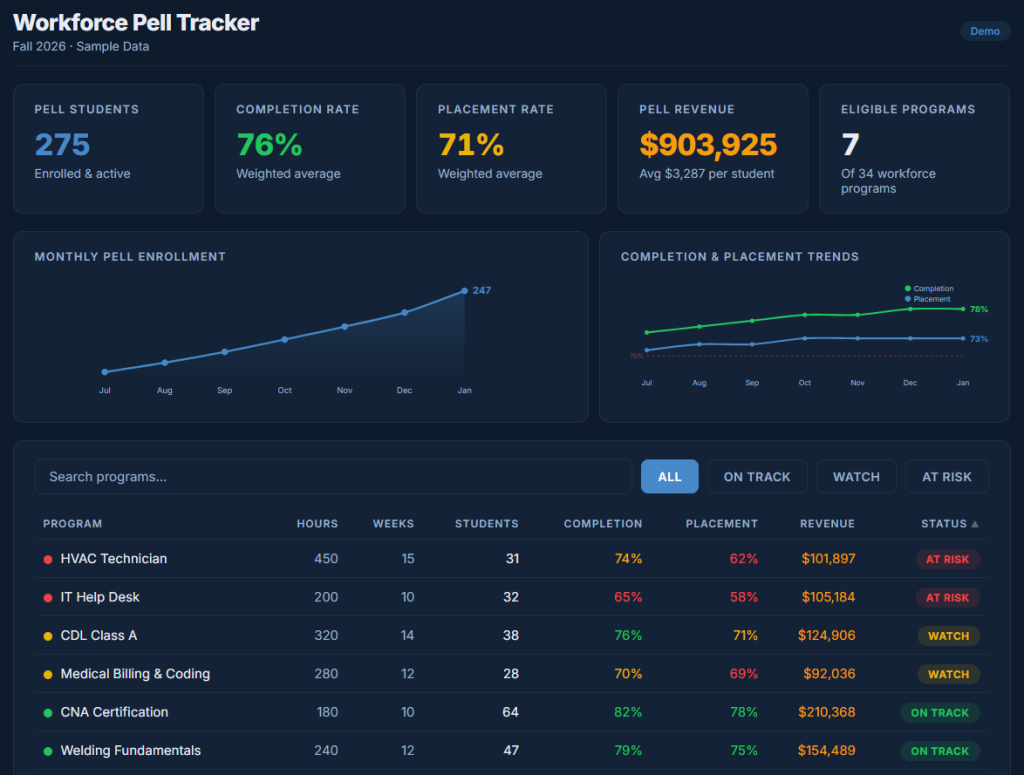
To show what’s possible when Enrole enrollment data flows into Informer, we built an example Workforce Pell Tracker. It’s sample data, but it shows the kind of real-time compliance visibility your institution could have.
See an example of a Workforce Pell Tracker
The main dashboard gives you the full picture at a glance: total Pell students, weighted completion and placement rates, total Pell revenue, and eligible program count. Two trend charts show monthly enrollment growth and completion/placement rates over time with the 70% threshold marked, so you can see at a glance whether programs are pulling away from the danger zone or drifting toward it.
Below that, a sortable program table lists every Workforce Pell program with clock hours, duration, student count, completion %, placement %, revenue, and a status tag, On Track, Watch, or At Risk. You can search and filter by status to zero in on the programs that need attention.
Click any program and you get a full detail view with five tabs:
- Overview — Individual completion and placement trend lines, enrollment growth, a student pipeline funnel showing enrolled → completed → placed → withdrew, and a quick status summary.
- Alerts — Expandable alert cards that flag specific risks with severity levels. HVAC Technician’s placement rate is at 62% with 8 of 24 completers not employed at 180 days. Each alert includes recommended actions: re-engage employer hiring partners, assign dedicated career coaches, verify unreported placements.
- Students — A full roster with progress bars, hours completed, attendance percentage, Pell award amount, status, and dates. At-risk students are highlighted, so advisors and program directors know exactly who needs outreach.
- What-If Simulator — This is where it gets interesting. Two sliders let you model scenarios: what happens to your completion rate if you re-engage 3 of 11 withdrawn students? What happens to your placement rate if 4 more completers find employment? The simulator recalculates projected rates, projected status (does the program cross back above 70%?), and projected Pell revenue in real time. It even tells you exactly how many more students you need to reach the threshold.
- Pipeline — A visual funnel showing the full student journey from enrollment to completion to placement, with drop-off annotations at each stage and rate gauges underneath.
Know the Rules Cold
The tracker shows you where you stand. But you also need a clear picture of what the rules actually are — the full eligibility framework, not just the 70/70 test.
We published a one-page Workforce Pell Compliance Overview that lays out the complete compliance picture: the 70/70 performance test, student eligibility requirements (citizenship, FAFSA, SAP, the new bachelor’s eligibility rule), 8 critical policy changes including governor approval and the SAI cap, and CBO budget projections. All sourced from the Federal Register NPRM.
Download the Compliance Overview
The State Layer Adds Complexity
States are responsible for calculating completion and placement rates throughout the program as there’s currently no federal takeover scheduled. What does change is the bar. From 2026–27 through 2028–29, states use a simplified placement standard (any employment in the second quarter after exit). Starting in 2029–30, the standard tightens to require placement in the trained occupation or a similar high-skill, high-wage, or in-demand one. Each state will have its own data systems, wage record access, and calculation methodologies. Your institution needs to produce data that satisfies both federal standards and your state’s specific requirements.
This is another reason why structured, auditable data from your enrollment system matters so much. If your completion and placement numbers live in spreadsheets, email threads, and ad-hoc surveys, they won’t survive a state audit, and they certainly won’t flow cleanly into whatever reporting framework your state’s workforce board establishes.
Enrole captures attendance and completion at the student-course level from actual enrollment records. Informer produces the dashboards and exports in whatever format your state requires. When the state workforce board asks for your completion data, you don’t scramble — you run a report.
Don’t Wait for the Letter
The 70/70 test isn’t designed to catch you off guard, but it will if you don’t have the infrastructure to monitor it. The institutions that succeed with Workforce Pell will be the ones that treat these metrics like operational KPIs, not annual compliance exercises.
That means investing in the data pipeline now: structured enrollment and completion data flowing from your enrollment system into real-time dashboards that give you early warning and time to act.
Next in the series: What Workforce Pell-Ready Actually Looks Like for Non-Credit Programs.
Don’t find out you’re failing the 70/70 test from a federal letter. See the Workforce Pell Tracker in action. Request a demo →
References:
- U.S. Department of Education. Accountability in Higher Education and Access Through Demand-Driven Workforce Pell:Pell Grant Exclusion Relating to Other Grant Aid; and Workforce Pell Grants. Notice of Proposed Rulemaking. FederalRegister, March 9, 2026. https://www.federalregister.gov/documents/2026/03/09/2026-04520/accountability-in-higher-education-and-access-through-demand-driven-workforce-pell-pell-grant
- UPCEA. Workforce Pell Grants for Short-Term Programs: A Primer and Update from Negotiated Rulemaking — Consensus Reached: What’s in the Draft Regulations. https://upcea.edu/workforce-pell-grants-for-short-term-programs-a-primer-and-update-from-negotiated-rulemaking-consensus-reached-whats-in-the-draft-regulations/
- American Association of Community Colleges (AACC). Summary and Analysis of Draft Workforce Pell Grant Regulations. December 2025. https://www.aacc.nche.edu/wp-content/uploads/securepdfs/2025/12/Workforce_Pell_Regulations_Summary12_15.pdf
- National Governors Association. Workforce Pell: An Overview for Governors. https://www.nga.org/publications/workforce-pell-an-overview-for-governors/
- New America. Workforce Pell: A State Playbook for Implementation. https://www.newamerica.org/insights/state-workforce-pell-grants-a-playbook-for-implementation/
- Workforce Pell Substack. Workforce Pell Negotiated Rulemaking Recap. https://workforcepell.substack.com/p/workforce-pell-negotiated-rulemaking-4ee
- Federal Student Aid. 2026–27 Student Aid Index (SAI) and Pell Grant Eligibility Guide. U.S. Department of Education. https://fsapartners.ed.gov/knowledge-center/library/handbooks-manuals-or-guides/2025-06-13/2026-27-student-aid-index-sai-and-pell-grant-eligibility-guide-updated-aug-25-2025