
The regulations are clear. The data infrastructure to meet them? For most institutions, it doesn’t exist yet.
Everyone’s talking about Workforce Pell as a policy story. New funding. New student populations. New opportunities. All true.
But underneath the policy layer is a data infrastructure problem that most institutions haven’t confronted yet, and it’s the thing that will actually determine who can participate on July 1 and who can’t.
Clock Hours, Not Credit Hours
The entire Workforce Pell eligibility framework is defined in clock hours. Programs must be 150–599 clock hours. Awards are pro-rated based on clock hours. Eligibility is validated against clock hours.
A clock hour is a unit of actual supervised instruction time — typically 50–60 minutes of structured activity within a 60-minute block. It measures time in the classroom, lab, or shop, not credits earned or calendar weeks elapsed. Breaks and lunch don’t count.
Most student information systems were built for degree programs that are semester-based and credit-hour-driven. The SIS knows how many credits a student is enrolled in. It doesn’t necessarily know how many supervised instruction hours they’ve attended in a 10-week welding program.
This isn’t a minor distinction. It’s a fundamental unit-of-measure gap. And if your system can’t track this data at the student-course level, you can’t calculate Pell award amounts, validate program eligibility, or produce the data that state workforce boards will require.
Enrole tracks CEUs and contact hours natively — the exact unit of measure that maps to the federal clock hour definition (supervised instruction time, excluding breaks). When a student enrolls in a 400-hour pharmacy technician program, Enrole captures that in contact hours, not as a conversion from credit hours. For Workforce Pell reporting, those contact hours are your clock hours, and they are already in the right format for federal and state reporting.
180-Day Outcome Tracking
The 70/70 test requires ≥70% completion and ≥70% job placement within 180 days of program completion. That means your institution needs a systematic way to track what happens to students after they leave; not at graduation, but six months later.
Most enrollment systems stop at completion. The student finishes the program, gets a certificate, and disappears from the data. There’s no structured mechanism to capture employment status at the 180-day mark, connect it back to the student record, and roll it up to the program level for compliance reporting.
The Department of Education acknowledged during negotiated rulemaking that there are “still many specifics to work out in terms of where earnings data will be pulled from, how data systems will be put into place.” States are responsible for calculating completion and placement rates throughout the program’s early years, and the bar gets higher over time. From 2026–27 through 2028–29, states use a simplified placement standard. Starting in 2029–30, the standard tightens. That means institutions need to feed clean, structured data upstream or risk their programs failing the 70/70 test on data quality alone.
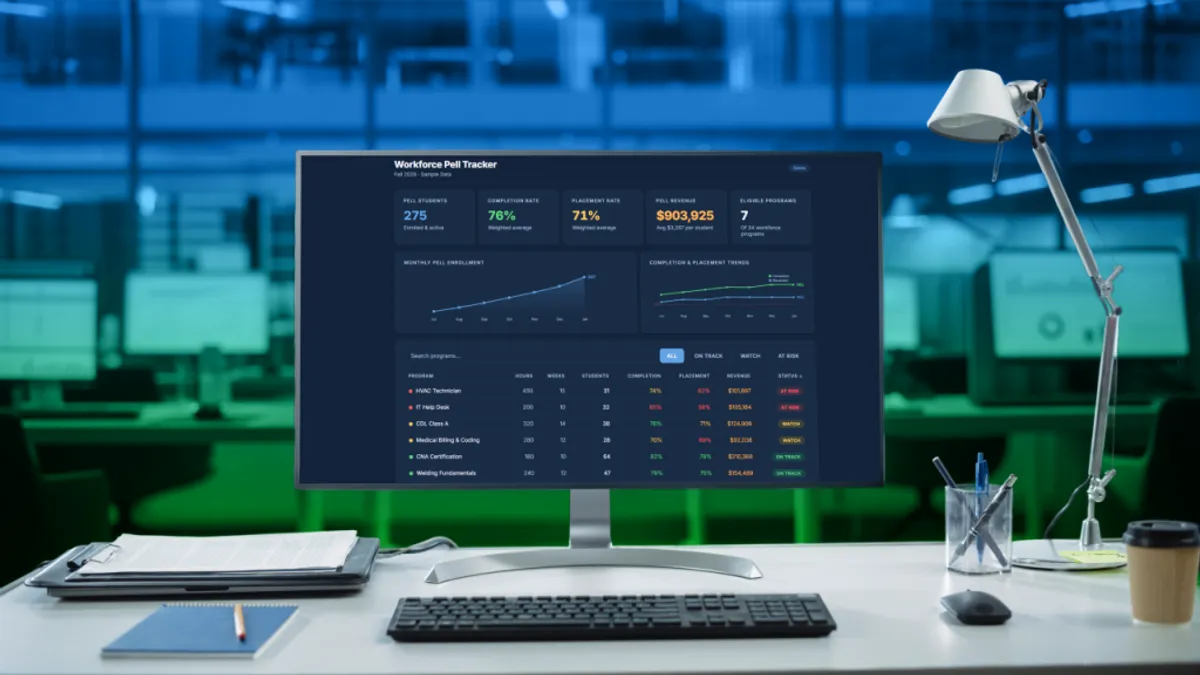
Enrole captures attendance at the student-course level and calculates completion status from actual enrollment records. This isn’t a formula in a spreadsheet; it’s structured data flowing from the enrollment system. When paired with Informer, that completion data becomes the foundation for 70/70 performance dashboards that track both metrics against the threshold in real time.
The Person + Course Data Model
Here’s what makes Workforce Pell compliance particularly demanding: you need data at two levels simultaneously.
By Person: A unified student record that tracks eligibility (citizenship, SSN, FAFSA, SAP), program enrollment, attendance, completion status, payment sources, credential attainment, and post-completion outcomes. You also need to monitor lifetime Pell usage toward the 12-semester cap because Workforce Pell counts against it.
By Course/Program: Program-level performance data that feeds the 70/70 test: completion rates calculated from enrolled-to-completed, job placement tracked at the 180-day mark, clock-hour totals, credential stackability, and alignment with state-defined high-demand occupations.
Most systems do one or the other reasonably well. Few do both, and even fewer can produce a joined view that satisfies both federal and state reporting requirements.
This is Enrole’s native data model. It collates data by person and by course-specific information which is exactly the dual-axis view that Workforce Pell demands. A single student record connects to their enrollment, attendance, completion, payment, and credential data. That same data rolls up to the program level for the 70/70 test. Informer sits on top and produces the dashboards, exports, and audit-ready reports from both views.
The Data Gap is the Real Readiness Gap
Institutions aren’t going to lose Workforce Pell eligibility because their programs are bad. They’re going to lose it because they can’t produce the data to prove their programs are good.
The institutions that solve the data problem first will be the ones that get programs approved first, enroll students first, and capture new federal funding first.
Next in the series: 70% Completion. 70% Placement. 180 Days. Are You Tracking Any of It? The 70/70 test deep dive and what happens when you fail, the two-year lockout, the earnings grace period, and what the compliance dashboard looks like in practice.
Your data infrastructure is either ready or it isn’t. See how Enrole closes the gap. Request a demo →