
By Dr. Karen Holding-Jordan, retired Dean of Continuing Education, Wake Technical Community College
The quality of your systems determines the capacity of your programs. I learned that truth over years of building continuing education programs at Wake Tech, growing enrollment, launching new workforce pathways, managing budgets, and keeping up with compliance requirements that seem to be ever-changing year after year.
CE and workforce development leaders are sitting in front of the biggest growth opportunity I’ve seen in my career. Record numbers of students are entering workforce training programs for Microcredentials, which are surging. Employer demand for short-term credentials keeps climbing. And for the first time, federal Pell Grant dollars are flowing to short-term workforce training programs.
The question isn’t whether the demand is there. It’s whether your infrastructure can capture it.
Workforce Pell Changes Everything
As of July 1, 2026, students can receive Pell Grants for enrollment in high-quality, short-term educational programs that prepare them for high-skill, high-wage, and in-demand jobs. That’s not a future milestone. It’s already here.
Think about what this means for your CE division. Students who couldn’t afford your CNC machining certificate, your phlebotomy program, your commercial driving course? They now have federal dollars behind them. That’s a direct line to enrollment growth and new revenue.
But those dollars come with real accountability.
Eligible programs must maintain a completion rate of at least 70%, measured within 150% of the program’s normal completion time, and a job placement rate of at least 70%, measured 180 days after completion. Institutions will eventually also be required to demonstrate that program graduates earn enough after completion to justify the total cost of attendance. And this eligibility isn’t permanent: programs that don’t meet the 70/70 requirement for any two out of three consecutive years will lose it.
Can you track all of that right now? Can you pull completion rates by program, by cohort, on demand? Can you match completers to employment outcomes 180 days out?
At Wake Tech, I knew we needed systems that could answer those questions without a three-day data pull. We implemented Enrole well before Workforce Pell was on anyone’s radar, because the operational problems were already real. Registration bottlenecks. Disconnected data. Manual processes that hindered growth. The fact that Enrole now positions us to meet Workforce Pell’s reporting demands is a bonus built on a foundation we put in place years ago.
The institutions that already have this infrastructure will be the ones that capture Workforce Pell’s full potential.
The Infrastructure Gap Holding Programs Back
Here’s a pattern I saw at conference after conference, talking with CE leaders from other community colleges: the CE office runs its own registration process, often not integrated with the SIS. Payment goes through a different workflow. Student records are manually entered into Colleague or Banner. Reporting is a manual exercise that requires someone to pull data from various sources, reconcile it in Excel, and hope the numbers match.
That disconnect is what hinders CE programs. Registration data living apart from your SIS. Payment processing apart from your finance system. Outcome tracking that doesn’t exist at all because nobody had to report it before.
Workforce Pell didn’t create this problem. It made solving it urgent. And it turned an operational inconvenience into a revenue risk.
What a Purpose-Built CE System Actually Solves
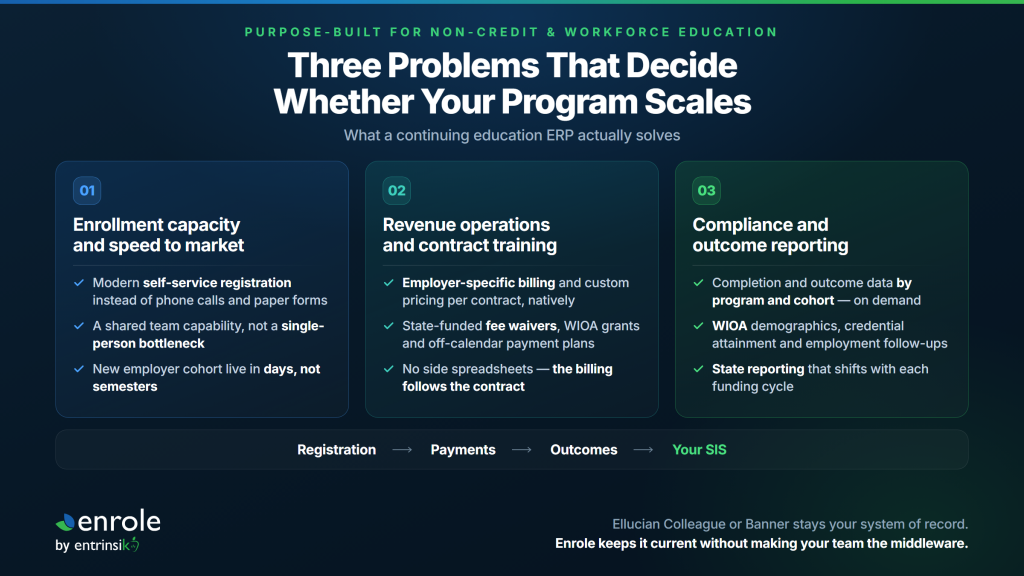
A workforce continuing education ERP, put another way, a system designed from the ground up for non-traditional education, solves three problems simultaneously. And they’re the three problems that determine whether your program grows or plateaus.
1. Enrollment capacity, learner experience, and speed to market
Manual registration processes cap how many students you can serve. Every phone call, every paper form, every staff member re-keying data into a separate system is a ceiling on your program’s capacity.
I lived this. My team lived this.
At Wake Tech, the student experience mattered deeply to me. Our CE programs represented the institution just as much as the credit side. When we moved to Enrole, we finally had registration infrastructure that reflected the Wake Tech standard, not a clunky workaround that made students question whether we had our act together.
Entrinsik understood the complexity of non-credit education. Enrole gave us the modern infrastructure we needed to scale efficiently while delivering a student experience that truly reflects the Wake Tech standard of ”Leading the Way”. That wasn’t just a technology win. It was a credibility win with our learners and our workforce partners.
A single-person bottleneck becoming a shared team capability. Students getting a modern self-service experience. That’s what enrollment growth actually requires. And when your registration process feels as polished as anything on the credit side, your workforce partners take your programs more seriously too.
But there’s another capacity question CE leaders don’t talk about enough: how fast can you stand up a new program? When an employer calls and says they need a forklift certification cohort running in two weeks, or a local hospital needs a new patient care tech pathway by next quarter, rigid semester-based systems force you into a months-long setup process. Enrole’s flexible scheduling model lets you build a new program, set custom fees, open registration, and go live in days. Not weeks. Not next semester. Days. That speed is what turns employer interest into signed contracts before they call another provider.
2. Revenue operations, contract training, and financial integration
Non-credit programs deal with fee structures that credit-side systems simply weren’t designed for. Employer-sponsored billing. Contract training with custom pricing. Fee waivers funded by the state and workforce grants. Payment plans that don’t follow a semester calendar.
If you’re managing contracted training, you know the complexity. You might have fifteen active employer agreements at once, each with its own negotiated pricing, its own billing contact, its own cohort structure. One employer pays per seat. Another pays a flat rate for a cohort of twenty. A third bills against a WIOA grant with completely different documentation requirements. Keeping all of that straight in spreadsheets or a system designed for credit-hour tuition? That’s where errors happen, compliance issues arise, and money gets left on the table.
Enrole handles employer-specific billing and custom pricing per contract natively. Each employer agreement carries its own rate structure, its own billing rules, its own student roster. Your staff aren’t toggling between systems or maintaining side spreadsheets to track who owes what. The billing follows the contract.
Here’s what that actually looked like at Wake Tech. When a workforce partner sent us a cohort of forty students with state-funded fee waivers, my staff had been hand-entering waiver codes into one system and toggling to another to send confirmation emails. Multiply that across dozens of employer partners and thousands of registrations per semester, and you start to see where the hours go. Enrole processed those registrations and communicated enrollment confirmations directly to students. Staff time that had been consumed by manual reconciliation each week got redirected toward building new employer partnerships and launching programs.
That shift from administrative survival to strategic growth is what separates CE programs that plateau from ones that scale.
3. Compliance, outcome reporting, and SIS integration
This is where Workforce Pell raises the stakes for every CE leader. Programs must demonstrate a 70% completion rate, a 70% job placement rate within 180 days, and eventually a value-added earnings test. Programs that don’t meet the 70/70 requirement for any two out of three consecutive years will lose eligibility. For programs seeking first-time eligibility, those metrics are applied retroactively, meaning states will have to certify that a program has been in existence for at least 12 months and has met the required thresholds during that time frame.
And Workforce Pell is only part of the compliance picture. If your programs receive WIOA funding, you already know the reporting burden: participant demographics, training outcomes, credential attainment, employment at multiple follow-up intervals. State-level compliance reporting adds another layer, with requirements that vary by state and change with each funding cycle. A system that can’t generate these reports on demand forces your staff into recurring manual data pulls that eat days every quarter.
You can’t assemble this data manually and expect to maintain eligibility year after year. You need registration, completion, and outcome data flowing through one system, connected to your SIS, connected to your reporting tools. The programs that lose Workforce Pell eligibility won’t lose it because their training is subpar. They’ll lose it because they couldn’t prove their outcomes.
That’s the real risk.
Let’s talk about SIS integration specifically, because “integration” is one of those words that can mean anything from a nightly CSV export to a real-time bidirectional data flow. Enrole integrates with both Ellucian Colleague and Banner. At Tulsa Tech, for example, Enrole runs automated hourly data transfers to Colleague, so student records, enrollment data, and payment information flow into the SIS without staff re-keying anything. That’s the difference between integration as a marketing term and integration as an operational reality. Your SIS is the authoritative system of record. Enrole keeps it current without making your team the middleware.
A purpose-built CE system handles compliance by design. Registration data, completion records, credential issuance, and reporting all live in one place. When the federal government asks for your 70% completion rate by program, by cohort, by year, the answer is a query, not a three-day data project. When your state asks for WIOA outcome data, same thing.
Because we implemented Enrole before any of these federal requirements existed, Wake Tech already had clean, connected data when the compliance conversation started. We weren’t scrambling to backfill records or reconcile spreadsheets. The reporting infrastructure was already there. That’s the advantage of solving the operational problem first: compliance readiness comes with it.
This is Your Growth Moment
The demand is there. The federal funding is there. Employers are asking for trained workers faster than most programs can deliver them. CE and workforce development programs have never been more essential to their institutions or their communities.
The programs that capture this moment won’t be the ones with the biggest staffs or the most generous budgets. They’ll be the ones with infrastructure that matches their ambition. Modern registration. Integrated payments. Compliance reporting that runs as a natural part of operations, not a scramble at the end of each cycle.
I’ve seen what that looks like in practice. It changes what’s possible.
What to Do Next
If you’re running a CE or workforce development program and you see the opportunity in front of you, the first step is making sure your systems match your ambition. Not a bigger staff. Not another spreadsheet. A system built for the work you’re actually doing.
Enrole is purpose-built for non-credit and workforce education. It handles registration, payments, employer billing, contract training workflows, SIS integration with Colleague and Banner, and the outcome reporting that Workforce Pell and WIOA demand, without requiring IT to build custom connections or your team to maintain parallel data entry.
Schedule a discovery call and walk through what a connected CE operation looks like for your institution.
Sources
- U.S. Department of Education, “Final Rule to Create New Workforce Pell Grant Program,” May 18, 2026. https://www.ed.gov/about/news/press-release/us-department-of-education-issues-final-rule-create-new-workforce-pell-grant-program
- NCAN, “Final Workforce Pell Grant Regulations Issued,” May 28, 2026. https://www.ncan.org/Web/Web/News/Final-Workforce-Pell-Grant-Regulations-Issued.aspx
- WCET/WICHE, “Workforce Pell Final Rules: Turning Policy into Practice,” May 29, 2026 — https://wcet.wiche.edu/frontiers/2026/05/29/workforce-pell-final-rules-turning-policy-into-practice-for-the-digital-learning-community/
- Jobs for the Future, “Mapping State Implementation of Workforce Pell: Quality Metrics,” June 16, 2026 — https://www.jff.org/idea/workforce-pell-implementation/quality-metrics/