
A guide for higher ed teams stuck between “we have data” and “we use data well.”
If you work in institutional research, the registrar’s office, IT, or finance at a college or university, you probably have a reporting tool. Maybe you’ve had one for years. It runs your IPEDS submissions, pulls enrollment numbers, generates the reports your provost asks for every semester.
And it works. Sort of.
But somewhere along the way, the requests started piling up. The VP of Student Affairs needs a retention breakdown by demographic. The CFO wants financial aid disbursement trends. The president’s office needs a board-ready summary by Friday. And every one of those requests lands in your inbox as a “quick report pull” that is never actually quick.
If that sounds familiar, you’ve probably outgrown standard reporting. Here’s how to know for sure.
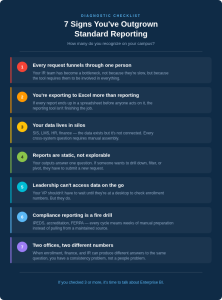
7 Signs Your Institution Has Hit the Reporting Ceiling
1. You’re the bottleneck, and everyone knows it.
When every data request flows through one person or one small team, you’ve created a single point of failure. It’s not a staffing problem. It’s a tooling problem. Standard reporting tiers typically don’t support self-service dashboards, which means department heads can’t explore data on their own. They have to come to you. Every time.
On a campus of dozens of departments with different data needs, that model doesn’t scale. You end up triaging requests instead of doing actual analysis.
2. You’re exporting to Excel more than you’d like to admit.
Here’s the cycle: run a report, export it, open Excel, reformat it, add a chart, paste it into a PowerPoint, email it to someone who asks you to change one filter, and start over.
If your reporting tool is mostly a way to get data out so you can do the real work somewhere else, it’s not really serving you. It’s just an extraction layer. Your tool should let you build the final product, not just supply the raw material.
3. Your reports look different every time.
Accreditation bodies, boards of trustees, and state agencies expect consistency. But when five different people are building reports with five different approaches and zero shared templates, the output is all over the place. Fonts, logos, layouts, terminology. None of it matches.
This isn’t a cosmetic issue. Inconsistent reporting erodes confidence in the data itself. When something looks thrown together, people assume the numbers might be too.
4. You can’t connect your systems.
Your SIS has enrollment data. Your LMS has student engagement data. Your HR system has staffing data. Your finance system has budget data. And none of them talk to each other through your reporting tool.
Standard reporting tiers often come with limited or read-only API access, which means you can’t automate the flow of data between systems. You’re stuck manually reconciling information across platforms, or worse, maintaining shadow spreadsheets that serve as the unofficial “source of truth.”
For a campus trying to build a holistic view of student success or operational efficiency, disconnected systems are a serious barrier.
5. Leadership asks questions your tools can’t answer quickly.
The provost doesn’t want to wait three days for a custom report. The enrollment management team doesn’t want last month’s numbers. They want to see what’s happening now, visualized in a way that makes the story obvious.
If your current setup can’t deliver interactive, real-time dashboards that leadership can actually use without your help, you’re spending your expertise on delivery logistics instead of strategic insight.
6. You’re preparing for accreditation the hard way.
Every accreditation cycle is a fire drill. You’re pulling data from multiple sources, formatting it to meet specific standards, and compiling it into reports that have to look polished and be defensible. If that process involves a lot of manual assembly and last-minute formatting, your tools aren’t doing their job.
Institutions that have moved beyond standard reporting typically handle accreditation prep with reusable templates, automated data pulls, and dashboards that stay current year-round, not just when the site visit is six months out.
7. Nobody can access anything on their phone.
This one’s simple. Your cabinet members, deans, and directors are in meetings all day. They’re not sitting at a desktop waiting to log into a reporting portal. If your data isn’t accessible on a mobile device in a format that actually works on a small screen, it might as well not exist for half your leadership team.
So now what?
If you checked three or more of those boxes, you’re not failing. You’ve just reached the ceiling of what standard reporting was designed to do. The tools got you this far, and that’s not nothing.
But the gap between “we have reports” and “we have a data strategy” is real, and it tends to widen over time. The requests keep growing. The systems keep multiplying. The expectations from leadership, accreditors, and students keep rising.
The good news is that closing that gap doesn’t require ripping anything out. If you’re already using Informer, Enterprise gives you the capabilities that directly address every one of the pain points above: self-service dashboards, full API access to connect your SIS, LMS, and HR systems, branded templates for consistent reporting, AI-powered visuals, and mobile access through Informer Go for the leaders who are never at their desks.
It’s the difference between a reporting tool and a data strategy.
Want to see what Enterprise looks like for your campus?
Schedule a quick call with our team and we’ll walk you through it using your actual use cases. No generic demo. No pressure.
This is Part 1 of our “Beyond Reports” series for higher ed.
Up next: “5 Things Your Campus Reporting Tool Should Do That It Probably Doesn’t.“