
If your reporting workflow still ends with “export to Excel,” this one’s for you.
Most colleges and universities have a reporting tool. It runs queries, pulls data, and spits out the numbers someone asked for. And for a long time, that was enough.
But the role of data on campus has changed. It’s not just about compliance anymore. Enrollment management teams need real-time visibility into funnel performance. Student success offices need early alert indicators. Finance needs to model scenarios, not just report on what already happened. And leadership expects all of it faster, cleaner, and more visual than ever before.
The problem isn’t that your reporting tool is bad. It’s that the demands have outpaced what it was built to do.
Here are five capabilities your campus should expect from a modern reporting platform, and probably isn’t getting today.
The 5 Capabilities That Separate Standard Reporting from Enterprise BI
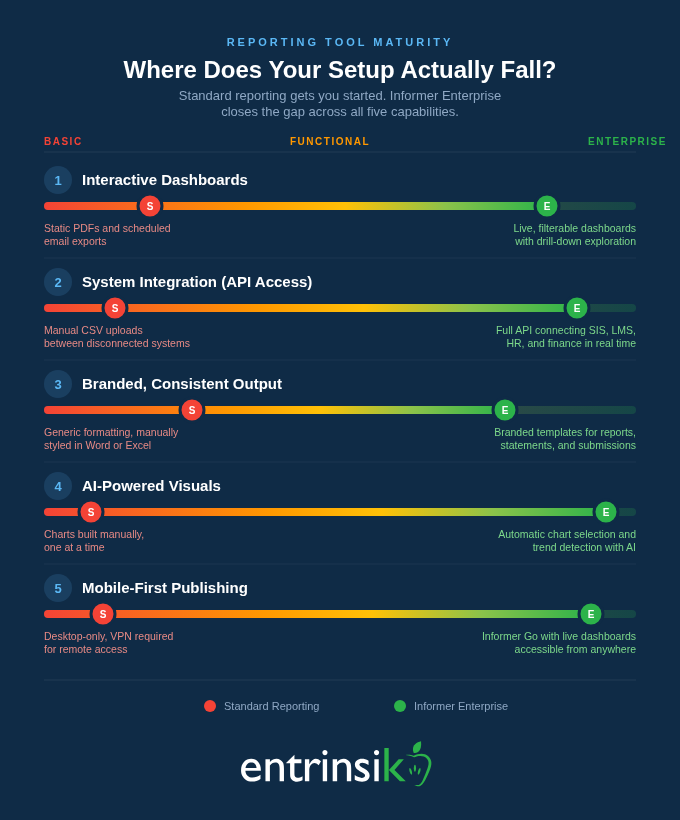
1. Interactive dashboards that people actually use.
There’s a difference between a report and a dashboard. A report answers a specific question. A dashboard gives someone the ability to explore, filter, and drill into data on their own without submitting a request and waiting.
Think about your enrollment management team during recruitment season. They don’t need a static PDF showing last week’s application count. They need a live view they can filter by program, by geographic region, by admit status, and they need it updated in real time.
Or think about your CFO preparing for a board meeting. A dashboard that combines budget-to-actual, financial aid disbursement trends, and tuition revenue projections in one view saves hours of assembly and gives the board something interactive to engage with instead of a stack of printouts.
If your current tool doesn’t let department heads, deans, and VPs explore data independently, every question still routes through your IR or IT team. That’s not a reporting strategy. That’s a ticket queue.
2. API access that connects your campus systems.
Higher ed runs on a patchwork of platforms. Your SIS handles enrollment and student records; your LMS tracks course engagement; your HR and finance systems live in their own worlds. And most of the time, none of them talk to each other through your reporting layer.
Full API access (read and write) changes that equation entirely.
With it, you can automate user provisioning, so new employees get reporting access the same day they’re onboarded. You can pull LMS engagement data alongside SIS enrollment data to build a real picture of student success, not just a transcript snapshot. You can trigger workflows when specific thresholds are hit, like flagging students whose engagement drops below a certain level mid-semester.
A lot of reporting tools offer limited or read-only API tokens. That’s fine for basic data extraction, but it doesn’t support the kind of integration that makes a campus data ecosystem actually function. If you’re still manually reconciling data across systems or maintaining spreadsheets that serve as the bridge between platforms, this is the gap.
3. Branded templates for reports that represent your institution.
Every accreditation report, board presentation, and state submission that leaves your campus is a reflection of your institution. When those documents are inconsistent, with mismatched logos, different fonts, varying layouts, it doesn’t just look sloppy. It quietly undermines the credibility of the data inside.
Branded templates solve this at the source. Build a report template once with your institution’s logo, color palette, and formatting standards, and every report that uses it comes out looking the same. Whether it’s your IR office generating IPEDS supplements, your finance team producing quarterly budget summaries, or your student affairs division reporting on retention initiatives.
This matters more than people realize during accreditation. Review teams notice when documentation looks cohesive and professional versus when it looks like it was assembled by six different offices with six different versions of Word.
4. AI-powered visuals and reports that surface what matters.
Your IR team shouldn’t have to spend 30 minutes deciding whether a bar chart or a line graph best represents a five-year enrollment trend. That’s exactly the kind of decision AI can handle.
AI-powered visualizations analyze your data patterns and automatically select the most effective chart type, highlight anomalies, and surface trends that might not be obvious in a table of numbers. For an IR director juggling dozens of data requests, that’s time back in the day.
Take it a step further with AI-generated reports that synthesize multiple datasets into a single summary. Imagine combining enrollment, retention, financial aid, and student engagement data into one intelligent overview for your president’s cabinet, without manually building every slide. That’s not a hypothetical. That’s what modern reporting platforms can do right now.
For campuses drowning in data requests, this is the difference between spending your time preparing information and actually analyzing it.
5. Mobile access that meets leadership where they are.
Here’s a reality of campus leadership: deans, VPs, and presidents spend most of their day in meetings, walking between buildings, or traveling for events and fundraising. They’re rarely sitting at a desktop with time to log into a reporting portal.
If your data isn’t accessible on a phone or tablet in a format designed for those devices, it’s invisible to the people who need it most. And “accessible” doesn’t mean a desktop report crammed onto a small screen. It means a purpose-built mobile experience with dashboards, KPIs, and AI-driven insights that are designed to be consumed on the go.
When your VP of Enrollment can check application numbers between meetings, or your CFO can review budget status from the airport, data stops being something people request and starts being something they live in.
The Common Thread
None of these five things are nice-to-haves anymore. They’re the baseline for institutions that want to move from reactive reporting to proactive, data-informed decision making. And if you look at the list, there’s a pattern: every one of them is about removing friction between the people who need data and the data itself.
If your current setup can do one or two of these, you’re in decent shape. If it can’t do most of them, the gap between where you are and where your campus needs to be is only going to grow as enrollment pressures increase, accreditation standards tighten, and leadership expectations rise.
Informer Enterprise was built to cover all five. Dashboards, full API access, branded templates, AI-powered visuals and reports, and mobile-ready experiences through Informer GO. It’s the tier designed for institutions that have moved past “just pull me a report” and into building a real data culture.
Ready to see what these capabilities look like on your campus?
Schedule a conversation with our team and we’ll show you how Enterprise fits your specific systems, workflows, and reporting needs.
This is Part 2 of our “Beyond Reports” series for higher ed.
Previously: “7 Signs You’ve Outgrown Standard Reporting“
Next up: “From Reports to a Data Strategy: What Enterprise BI Looks Like in Higher Ed.“