For most independent insurance agencies, commission reporting is a familiar ritual.
Pull the data from the AMS. Export it. Clean it up. Reconcile it against carrier statements. Check the numbers. Build the spreadsheet. Send it around. Then, somewhere along the way, someone finds an exception that needs investigating.
By the time the final report is ready, two days may have disappeared from the calendar.
And then the cycle starts again.
The frustrating part is that the information was already sitting inside the agency’s systems.
The real problem isn’t access to data. It’s the amount of work required to turn that data into something useful.
The Two-Day Reporting Problem
Commission tracking is one of those workflows that agencies have learned to tolerate because there hasn’t been an obvious alternative.
But consider what those hours actually represent.
Most reporting cycles look like this:
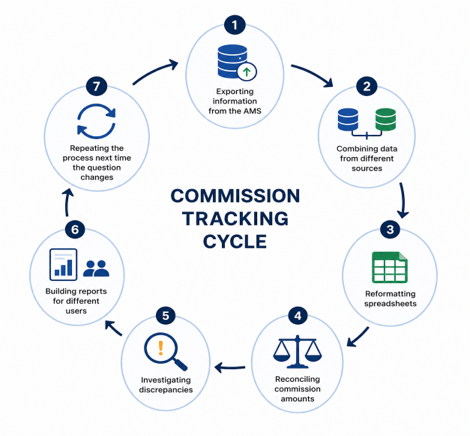
None of these tasks generate revenue.
They don’t improve client relationships.
They don’t help producers sell more.
This process simply gets the agency to the point where someone can finally see what is happening.
That’s the hidden cost of manual reporting.
What If You Could Just Describe the Problem?
This is where the next generation of agency technology starts to look very different.
Instead of starting with:
“What report do I need?”
Imagine starting with:
“I need to see which commissions are outstanding, which carriers are creating discrepancies, and where we need to follow up.”
Then getting a working application built around that problem. No requirements document. No six-month technology project. No waiting for someone with specialized technical skills to translate the request into a report.
With Informer Apps, users can describe what they need in plain language, and Informer’s AI-powered App Builder turns that description into a working application built on the agency’s connected data. The app can then be refined conversationally — add a filter, flag discrepancies, route exceptions to a specific team — without writing code or submitting a requirements document.
That changes the role of the operations team. They’re no longer simply waiting on an IT backlog to prioritize their request. They can describe the problem and help build the solution themselves.
Three Questions Before Lunch
The real opportunity isn’t just faster commission reporting, It’s giving the people closest to the workflow the ability to solve the problems they encounter every day.
Imagine an operations lead being able to ask:
- What am I trying to see?
Outstanding commissions, discrepancies, carrier performance, producer activity, or something else? - What should happen when I find an exception?
Flag it, assign it, investigate it, follow up, or track it to resolution? - Who needs to see the result?
Accounting, producers, management, or a specific team?
Those are business questions, not IT requirements. That distinction matters, because most agency operations teams don’t need another technology project, they need a faster way to turn a problem they understand into a solution they can actually use.
From Reporting to Running the Workflow
This is the bigger shift behind Informer Apps. Traditional reporting gives you an answer. An application can give you a way to act on the answer.
That could mean moving from a commission report to a commission reconciliation workflow. From a list of renewal exceptions to a tracker that assigns follow-up. From a static performance report to an operational tool that lets teams investigate and manage what they find.
And because these apps sit within the Informer platform, they can work with the data and governance already in place rather than creating another disconnected system. Informer connects directly with AMS360, Applied Epic, and Sagitta, giving agencies a way to work with their operational data without relying on manual export workflows.
Two Days Is a Workflow Problem
North Risk Partners provides a useful example of what happens when agencies remove the manual reporting bottleneck. Reporting that once took a day and a half to compile in spreadsheets now runs instantly, freeing the team to focus on higher-value work.
That’s more than a faster report, It’s a different way of working.
The question for agency leaders isn’t simply:
“How can we build this report faster?”
It’s:
“Why are we still building this report manually at all?”
The agencies that ask that question will start finding opportunities to eliminate repetitive reporting workflows, give operations teams more independence, and turn agency data into something people can actually use in the moment.
Because your commission report shouldn’t take two days, it should take two minutes.
Ready to move faster, see further, and work smarter? Let’s talk.