

Many insurance leaders trust their dashboards, renewal reports, and performance metrics to guide important decisions. But behind the scenes, a small data inconsistency can quietly distort the entire picture. One of the most common examples agencies face today is the misclassification of expired policies as canceled policies inside AMS environments like AMS360.
At first glance, this may seem like a minor data issue. In reality, it can ripple across reporting, strategy, and leadership confidence in ways agencies often don’t realize until decisions begin producing unexpected outcomes.
The Hidden Reporting Risk Inside Policy Status Data
Insurance agencies rely heavily on policy status fields to measure performance. Retention rates, producer performance, revenue forecasting, and Book of Business analysis all depend on accurate classification.
When, for instance, expired policies are mistakenly labeled as cancellations, reporting starts telling the wrong story.
Leaders may see rising cancellation rates and assume clients are leaving. Producers may appear to be losing accounts they never actually lost. Forecasting models may signal declining revenue when the business is simply cycling through normal policy expirations.
The issue isn’t a lack of reporting. It’s a lack of data accuracy feeding the reporting layer.
And when reporting reflects flawed inputs, even the most sophisticated dashboards lose credibility.
How Bad Policy Data Erodes Trust in Reporting
The downstream impact of incorrect policy statuses extends far beyond a single report. Over time, teams begin compensating for unreliable data. Analysts export spreadsheets to verify numbers manually. Finance reconciles totals across multiple reports. Operations double-check dashboards before sharing them upward.
Reporting slowly transforms from a decision-making tool into a manual safety net designed to catch errors.
And once leadership starts questioning whether reports are accurate, the real cost emerges, hesitation.
Decisions slow down. Opportunities are missed. Confidence fades.
When Reporting Becomes Reactive Instead of Strategic
You’ve likely experienced this moment.
You walk into a leadership meeting with multiple reports in hand, only to spend the first half of the conversation debating which numbers are correct instead of discussing what actions to take.
This is not a reporting problem. It’s a data foundation problem.
When policy data is inconsistent:
- Analysts spend more time fixing reports than generating insight
- Leaders delay decisions while validating numbers
- Teams rely on side spreadsheets instead of shared dashboards
Instead of enabling speed of decision-making, reporting becomes a bottleneck.
And in a competitive insurance market, delayed decisions carry real financial consequences.
Why Accurate Data Is the Foundation of Strategic Reporting
Modern reporting platforms are designed to deliver the answers you need, when you need them. But insight depends on clean, trustworthy data.
Strategic reporting requires three things:
- Accurate operational inputs
- Automated validation processes
- Continuous data governance
Without these elements, agencies remain stuck in reactive reporting cycles, regardless of how advanced their analytics tools may be.
This is where a new approach to reporting begins to change the conversation.
Introducing Automated Data Cleansing Through Informer
Instead of simply displaying inaccurate data faster, Informer has partnered with Data Cleanse to help agencies identify, correct, and prevent reporting errors directly within their AMS environment by:
- Automating Data Issue Detection
Informer and Data Cleanse surfaces inconsistencies such as:
- Policies beyond their expiry date with incorrect status
- Missing customer information
- Duplicate or conflicting records
Agencies gain visibility into often hidden bad data before this data impacts reporting outcomes.
-
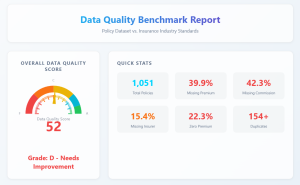
Click to explore an interactive demo of the Data Quality Benchmark Report. Creating a Data Report Card
Informer and Data Cleanse introduce a clear “Data Quality Benchmark Report” that highlights:
- Data gaps
- Quality risks
- Fields impacting reporting accuracy
- Operational patterns causing inconsistencies
This transforms data quality from a technical problem into a business insight leaders can act on.
- Introducing Write-Back Capabilities to AMS360
With Informer and Data Cleanse agencies can write corrected data back into their AMS, ensuring errors are resolved at the source rather than patched in spreadsheets.
This means:
- Cleaner data moving forward into Informer
- More reliable reporting automatically
- Less manual intervention from analysts
Reporting becomes self-improving instead of self-correcting.
Restoring Confidence in Agency Reporting
When data cleansing becomes automated, something important happens across the organization. Reports stop being questioned. Dashboards become trusted again. Analysts return to insight generation instead of report repair.
Producers gain accurate visibility into performance. Leadership sees a reliable view of agency health. Teams align around a single source of truth.
Most importantly, agencies regain speed of decision-making, one of the most critical competitive advantages in today’s insurance landscape.
If you’re ready to move faster, see further, and work smarter? Let’s talk.